
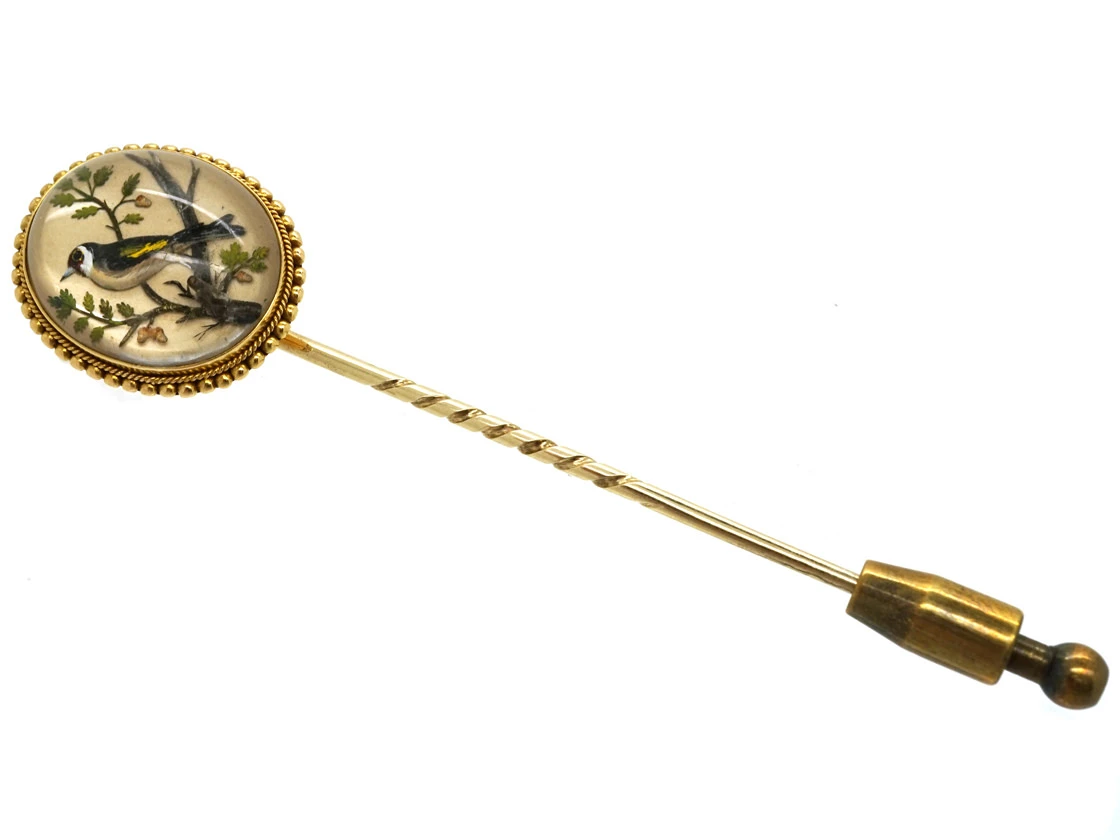

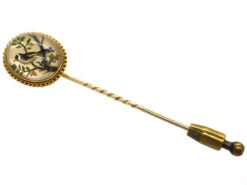
Victorian Reverse Painted & Carved Rock Crystal Tie Pin Of A Goldfinch By Pradier
Original price was: £340.00.£95.99Current price is: £95.99.
- Shop quality, shop with us.
- Quick responses, top-notch service.
- Safeguard Your Shopping Experience
- The home of quality products.

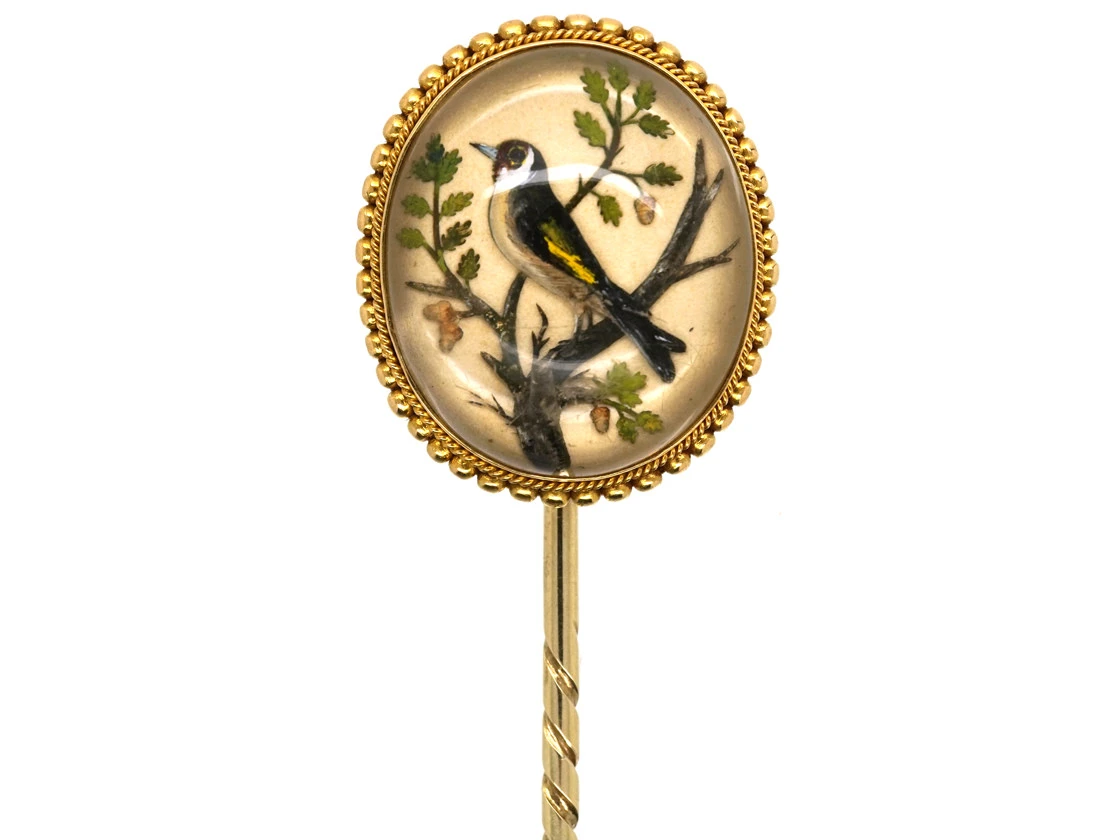
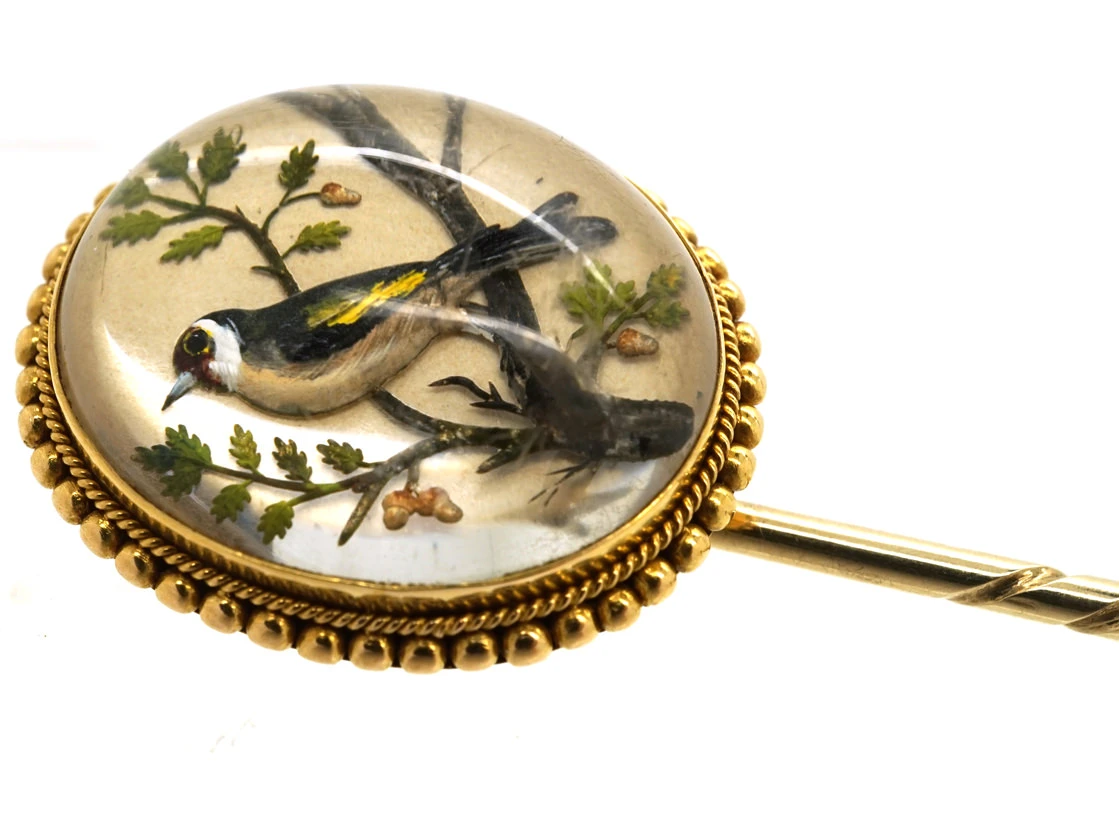
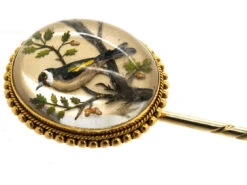
An unusual tie pin of a goldfinch sitting among the branches of an oak tree with acorns. The goldfinch is native to Europe. It has a red face and a black and white head, buff chest and black wings with a broad yellow bar and black tail.
The process used to create this miniature work of art is called “reverse intaglio”. The technique began in Europe, and has been attributed to a Belgian artist named Emile Marius Pradier. In England around 1860 Thomas Cooke also began making crystals for Lambeth and Company in England. Crystal carving and painting has always been a family enterprise and is one of the few art forms of modern times to develop in secrecy, being passed on from one generation to the next and is considered to be one of the highest art forms as rock crystal is incredibly hard to engrave. The quality and detail in this tie pin is amazing. There is a branch that nearly reaches the surface of the crystal. Pradier often displayed his artistry by taking the risk of the crystal shattering by doing this, so this pin may well have been executed by him.
The precise physical process of the reverse carved intaglioAn engraved stone, the opposite of a cameo, with a recessed design cut below the surface of the stone. Intaglio designs are common for signet rings and fob seals. crystal is a long and tedious one. Rock crystal mined in Brazil and Madagascar is cut with diamondA precious, lustrous gemstone made of highly compressed carbon. Diamonds are one of the hardest materials known to mankind. Colours of diamonds range from colourless, yellow, orange and brown to almost black. Natural coloured (or ‘fancy’) diamonds can be extremely rare. The cut, colour, clarity and carat weight of a diamond are the criteria jewellers use… saws and then ground to the perfect cabochonA polished, not faceted, dome shaped stone – either round or oval with a flat polished base, primarily used as a cut for phenomenal stones such as cat’s eyes and stars.
. This procedure could take as many as twenty different grades of polish, and the entire process is done by hand. Once the stone is shaped, the design is drawn on the reverse side of the crystal with water colour. The image is then etched into the piece of stone with a scribe pencil.
The engraving begins with handmade soft steel tools. As many as 250 of these tools may be used to execute this process. The crystal is carved with a pasteGlass made to resemble gem materials, which may be moulded, faceted, carved, etc. made from a combination of oil and diamond dust. When the image has been completed to the artist’s satisfaction, he begins painting the crystal. Just as in the carving phase, the painting is done in reverse. Sometimes the brushes that are used have only a single hair.
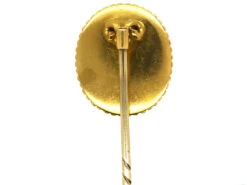
The quality of a fine crystal far outweighs the setting. However, the early VictorianJewellery made in the the Victorian era (1839-1901). mountings are generally as much a work of art as the crystal itself. The mount on this crystal is 18ct75% pure gold (or 750 parts pure gold and 250 parts other metals) gold and is decorated with a rope twist and bead work.
Print Out
889K
Width 1.8 cm
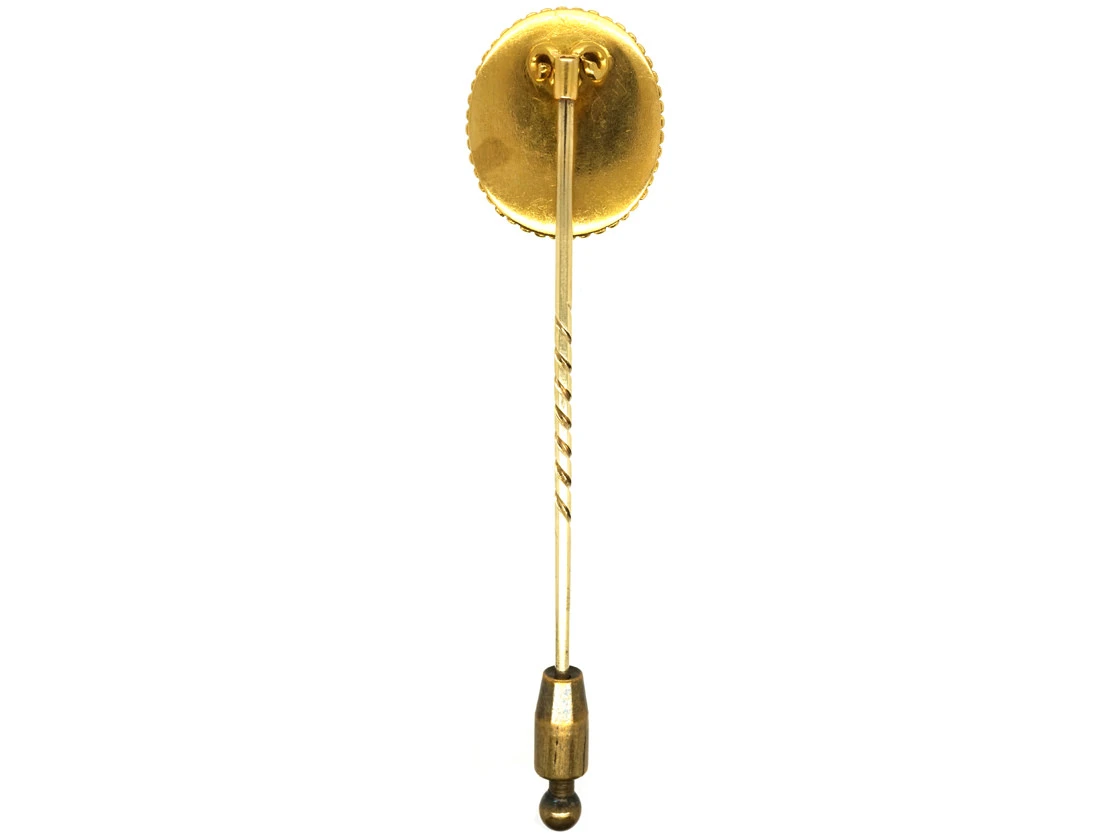
Length of pin 7.7 cm
English
Unmarked, tested to 18ct gold
Be the first to review “Victorian Reverse Painted & Carved Rock Crystal Tie Pin Of A Goldfinch By Pradier”
Related products


Men's Jewellery



Men's Jewellery
Men's Jewellery

Men's Jewellery


Men's Jewellery
Victorian 18ct Gold Coronet & Monogram Tie Pin That Belonged To The 4th Duke Of Wellington

Men's Jewellery
Reviews
There are no reviews yet.